
8.5. – 21.6.2026. Exhibition opens on 7.5.2026 at 18-20.
“Around God, there forms a Choir of prayers and Ceremonies and Rituals and Priests and Churchmen, until Finally God Dies. And not everyone always notices this.”
(Abraxas in Terry Pratchett. Small Gods. Finnish ed. Hämeenlinna: Karisto, 2004, 158)
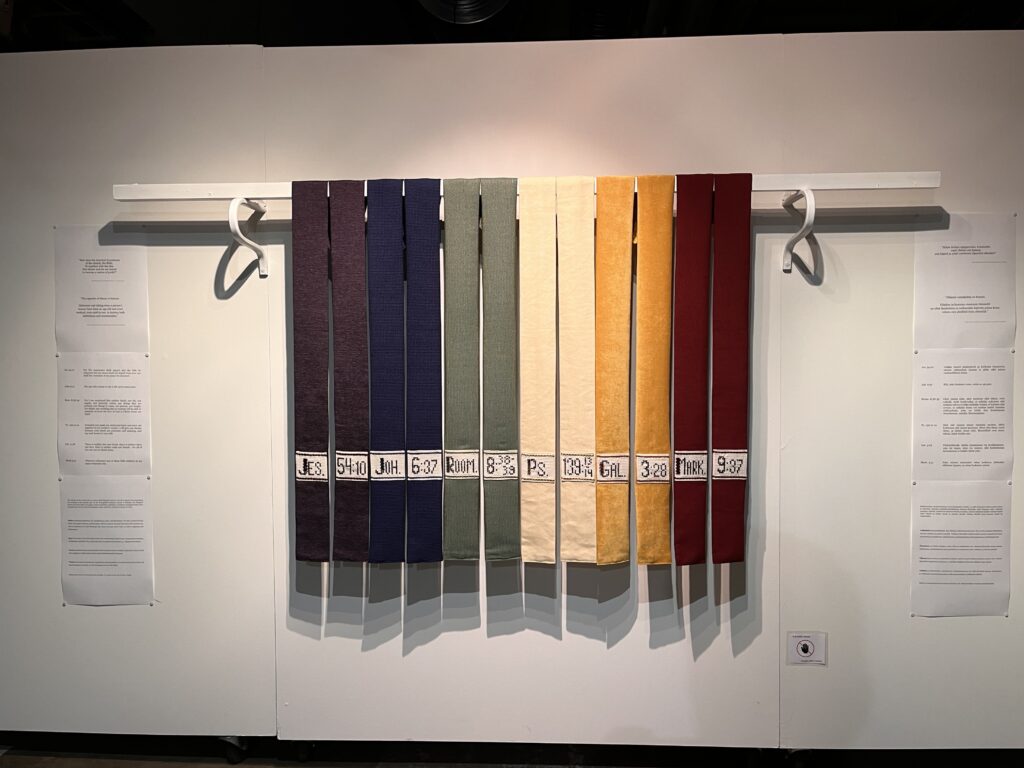
Can death — or life — be shaped into a theological doctrine? How do readymade texts encounter a human being, and what does it look like when a system responds to a human need?
The exhibition explores humanity within Christian culture primarily through two questions: how to encounter another human being, and how to encounter the finitude of life. It examines the relationship between humanity and systematization, and how the encounter with human life and death unfolds within that relationship. How have things been articulated, and what kind of reality words create? Does the church explain how things are? Can church still be a church if it only reflected? Offering locked-in answers makes universally human—and thus recognizable—questions harder to recognize. Although people long for continuity and stability, a rigid system hardly is the answer. What has remained recognizable throughout the ages are the kinds of experiences that occur in human lives across all times.
On the other hand, does a prayer or religious phrase necessarily—or at all—carry insight into reality simply because some people understand it in a certain way? Can one find genuine meaning in such words without subscribing to the dogma built around them?
—
“People start by believing in a god and end up believing in a structure.”
(The Turtle in Terry Pratchett. Small Gods. Finnish ed. Hämeenlinna: Karisto, 2004, 158)
THE RESEARCH
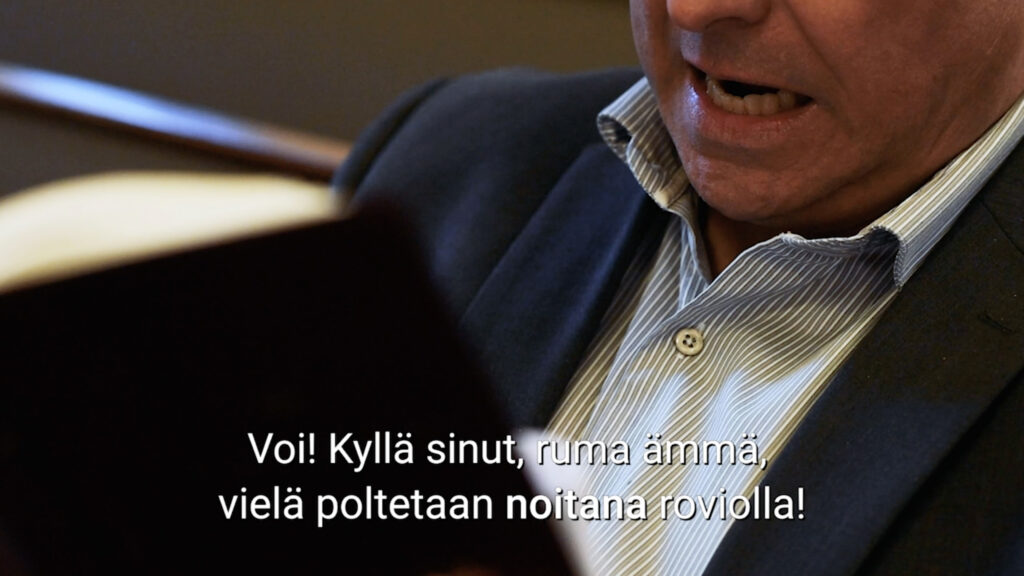
The exhibition draws on Leena Julin’s doctoral research Shared Humanity. Artistic research on recognizable and non-recognizable elements for present-day people in the Christian tradition, which explores the intersections and points of tension between Christianity and contemporary human experience. It is an art as research-type artistic study, where art serves both as a research tool and as a platform for presenting the findings. Julin conducts her research at the University of the Arts, Helsinki.
The aim of the research is to identify elements within the Christian tradition (in general, and specifically within the practices of the Evangelical Lutheran Church of Finland) that are recognizable regardless of personal conviction, as well as contents that alienate or exclude people. These elements are examined and interpreted through artistic means. The three focused themes of the research are:
1) Existence between time and eternity. The first artistic component published in November 2024 explored presence achieved through listening, the relationship between transience and eternity, and the potential of Christian language to articulate existence at the boundary of the ephemeral and the eternal.
2) Encountering other people, in Christian terms: love thy neighbor. Topics within this theme include questions about how others are treated, helping others, human rights in a religious context, and inclusion and exclusion.
3) Facing death and grief. This theme focuses on the kinds of explanations or expressions that have been given for death and mourning, and the kinds of affordances for mourning Christianity provides.
The second artistic component, a concert held in April 2025, and the final artistic part, an exhibition in November 2025, focus on the latter two themes. However, the themes of presence, time and eternity, and articulating the unspoken are essential throughout all parts of the research. The exhibition at Critical Gallery is a somewhat reduced version of last November’s exhibition.
As research material, Julin uses officially and/or publicly expressed content (e.g., responses or comments from bishops) and formulations from established sources (e.g., The Book of Church Services, The Hymnal). It is important to note that in practice, not everything is delivered exactly as written; many church workers adapt texts, consider human situations and experiences, and carry with them a wealth of professional expertise. A separate study could be conducted on the distance—or even the gap—between church materials and practical work. The selection of source material was guided by the fact that, for example, in funerals—situations where the church most often encounters grieving individuals—the primary textual materials used are The Book of Church Services and The Hymnal, which contain theological formulations related to death.
Christianity, of course, also includes expressions and forms that have the potential to resonate with people who think differently. It can offer traditions to lean on in times of shock, and a community with whom to share at least part of the grief. But this community must not explain grief away with dogma, offer comfort that is actually an imposition of one’s own thinking, or declare “truths” about the meaning of the event, what has happened to the deceased, or what the mourner should learn or do next.
On the other hand, silence or inaction is also a response. If the world around us changes and we choose not to react, that is a kind of response. If people suffer and no one speaks up for them, that is a kind of response. If encountering one’s neighbor requires action but we settle for reading prewritten texts, that too is a kind of response.
The same challenge of offering ready-made answers, repeating familiar practices, and valuing others through locked-in thinking applies to any worldview we are attached to. The “other” can be defined (or pre-judged) from many directions. And nothing is black and white. While some of the texts examined in the exhibition are abrupt, alienating, or even harmful, many also contain insightful observations (more or less fluently expressed). Maybe by lingering with them, one might also resonate with their content, as happened to the artist. It is fascinating how the same material can simultaneously repel and invite.
Leena Julin
—
Thanks for the support:

Critical Gallery, Helmet, Jukka J., Kai J. M., Nils J. M., Nina L., Otso A., Tamara F.-J., Timo K., äiti, and everyone else who have offered support and served as a source of material.
—
Polish-American scientist and philosopher Alfred Korzybski remarked that “the map is not the territory” and that “the word is not the thing”, encapsulating his view that an abstraction derived from something, or a reaction to it, is not the thing itself. https://en.wikipedia.org/wiki/Map–territory_relation